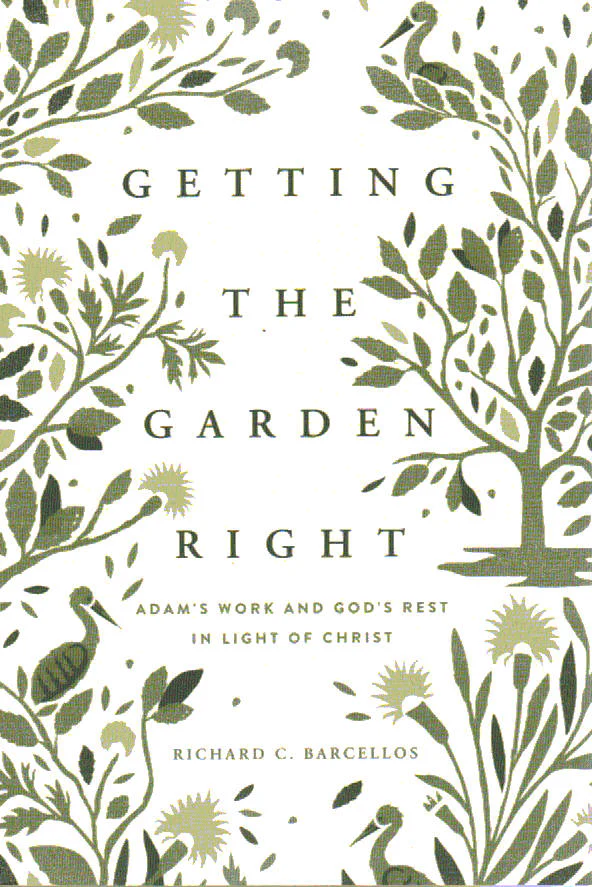
Summary of Dr. Richard Barcellos’ introduction to his book Getting the Garden Right: Adam’s Work and God’s Rest in Light of Christ, presented at a Free Grace Baptist Church theology study.
What happens when you don’t understand the first three chapters of the Bible? According to Dr. Richard Barcellos, you end up misunderstanding the rest of it—including the covenant of works, the Sabbath, the person and work of Christ, and the glorious destiny of every believer.
In a recent theology study hosted by Free Grace Baptist Church in Chilliwack, BC, Dr. Barcellos introduced his book Getting the Garden Right: Adam’s Work and God’s Rest in Light of Christ (Founders Press). What followed was a candid (and sometimes humourous) look at why he wrote the book, what theological problems it addresses, and why the stakes are higher than many Christians realize.
A Book Born from Struggle
Dr. Barcellos was candid about the origins of this book: it grew out of his own inability to clearly articulate doctrines he believed but hadn’t fully worked through. In the early 1990s, while preaching a series on the doctrine of man, he stopped right before the Fall—because he was “fuzzy on the covenant of works.”
That fuzziness sent him on years of reading through the works of G.K. Beale, Geerhardus Vos, John Owen, and others. What started as two planned sermons on creation eventually became twenty-two, which became his earlier book Better Than the Beginning, which in turn laid the groundwork for Getting the Garden Right—what Barcellos calls Better Than the Beginning “on steroids.”
The two central issues he wrestled with were the covenant of works and the Sabbath, and how they relate to one another. “I didn’t struggle with believing them,” he clarified. “I struggled with articulating them in a way that’s convincing—convincing to me.”
Saturday Morning Theology Study
This session was part of the bi-weekly Saturday Morning Theology Study at Free Grace Baptist Church — 6:30 AM Pacific, every other Saturday.
Join us in person in Chilliwack, BC, or online via Zoom. All are welcome.
Method Matters: Letting Scripture Interpret Scripture
One of the most important parts of the book, according to Barcellos, is Chapter Two: “The Importance of Hermeneutics and Theological Formulation.” This is where he lays his “methodological cards on the table”—explaining how he arrived at his conclusions.
His approach rests on the principle that Scripture interprets Scripture. He points out that the themes Moses introduces in Genesis are picked up and developed by later biblical writers—the Psalms, the Prophets, our Lord Himself, and the apostles. Barcellos quoted John Owen’s insight that the prophets serve as Moses’ “expositors,” unpacking what the Pentateuch first reveals.
“When you have the word of God on the Word of God,” Barcellos said, “you have the word of God on the Word of God.”
This means we must read Genesis 3 through the lens of Paul in Romans 5—not because Moses is insufficient, but because God designed His revelation to be “self-illuminating” and “mutually illuminative.” The analogy of Scripture and the analogy of faith, guided by the historic creeds and confessions, form the hedges within which faithful interpretation takes place.
Adam Had an Eschatology
When this method is applied to Genesis 1–3, a clear picture emerges. The garden was not merely a nice place to live—it was the first sacred space, the first “church-state,” where God dwelt with His people. Adam was placed there under the covenant of works with a goal: obedience that would have led to a glorified state better than his created condition.
“If Adam already had it, he didn’t fail to attain it,” Barcellos argued. “He was endowed with something good, but there was something better. Adam had an eschatology.”
That eschatology points directly to Christ. Whatever Adam failed to achieve, the Last Adam accomplished. And Paul’s deliberate choice of “Last Adam” (not “Second Adam”) is significant—it hints that there are other Adam-like figures throughout redemptive history, but Christ is the final and definitive one.
The Divine Rest: The Big Thing of Creation Week
Barcellos argued that the climax of the first week of the world is not the creation of Adam and Eve on the sixth day. It is the seventh day—the Divine Rest. This rest functions like a coronation, signifying the completion of God’s work and the establishment of His rule. It symbolizes a state of consummate glory that man could have “graduated to” by obedience, but which Adam forfeited through sin.
This leaves humanity in what Barcellos called “a plight”—not only creatures less than glorified, but now guilty and polluted. The solution? “The incarnation, sufferings, and glory of Christ, which is first revealed to us in Genesis 3:15.”
New Covenant Theology and Progressive Covenantalism
Part of what prompted the book was a real pastoral crisis. Members in Barcellos’ church had been influenced by New Covenant Theology (NCT), a system that denies the covenant of works, rejects any perpetual moral principle in the fourth commandment, and argues that the Sabbath “came with Moses and went with Moses.”
Barcellos addressed both NCT and its more academically refined successor, Progressive Covenantalism (associated with scholars like Stephen Wellum and Peter Gentry). While he commends the Progressive Covenantalists for going further than the older NCT—for example, acknowledging a “covenant of creation”—he challenges them to follow their own method more consistently.
“Use the method you’re using on the covenant with God and Adam,” he urged. “Use that on the divine rest, and you’ll be forced to come up with a different conclusion than an anti-Sabbatarian view of the Lord’s Day.”
The Problem with Secondary Sources
One of Barcellos’ recurring concerns is that contemporary scholars who argue against the confessional Sabbath position have not adequately engaged the primary sources. He pointed to D.A. Carson’s influential volume From Sabbath to Lord’s Day as an example. The book includes a chapter on the history of the doctrine—yet John Owen’s name does not appear in the index.
Owen’s treatment of the Lord’s Day in his Hebrews commentary (Volume Two, Exercitation Four) is, in Barcellos’ estimation, among the most powerful arguments ever made for the confessional position. He also noted the earlier work of Nicholas Bound on the Sabbath, which was foundational for many of the Puritans. To write a book pushing against the confessional view without engaging either of these men, Barcellos argued, is to rely on insufficient ammunition.
He also highlighted the work of Dr. Robert Martin, whose book on the Sabbath treats every relevant text in the Old and New Testaments and critiques Carson’s volume extensively. Barcellos credited Martin’s work as an influence on his own engagement with these issues.
On the exegetical level, Barcellos drew attention to Mark 2, where Jesus says “the Sabbath was made for man, and not man for the Sabbath.” Carson acknowledges that most commentators believe Jesus is referring back to creation—but dismisses this as “too tidy.” Barcellos found this cavalier: the statement seems to make man and Sabbath coextensive in origin. Man came first, and then God gave him a Sabbath for his benefit.
Peter Gentry on Romans 3:19 — A Novel Reading
Barcellos also addressed what he sees as problematic exegetical novelties among Progressive Covenantalists. He pointed to Peter Gentry’s treatment of Romans 3:19–20, where Paul writes, “Now we know that whatever the law says, it says to those who are under the law, that every mouth may be stopped, and all the world may become guilty before God.”
Gentry argues that only the Jews were “under the law” in the Mosaic sense, and then treats Israel as a kind of Adam-like representative figure—an exemplar whose guilt models the guilt of all. Barcellos’ response was direct: this reading is a novelty. You could survey fifty commentaries on Romans and not find it. These kinds of exegetical moves, he argued, may fit the Progressive Covenantalist system, but the system itself is not as systematic as it claims to be. And when it breaks down, it obscures major threads of Scripture—like the divine rest and the glory that believers will one day obtain.
Earlier Forerunners and Allies
Pastor Butler asked whether earlier biblical theology writers like Thomas McComiskey and William Dumbrell were proto-Progressive Covenantalists. Barcellos agreed—much of their work was good but left something unfinished. When G.K. Beale came along, particularly with his A New Testament Biblical Theology, Barcellos found sections on the divine rest that were genuinely helpful and that he leaned on in his own work. He also commended John Fesco’s Last Things First and Guy Waters’ book on the Lord’s Day (published, notably, by Crossway) as solid contributions to the discussion.
How Did We Get Here? The Enlightenment and Modern Hermeneutics
During Q&A, one attendee asked a pointed question: how did we get from the dominant sabbatarianism of the 17th and 18th centuries to the anti-Sabbatarian positions of contemporary scholars?
Barcellos traced the shift back to the Enlightenment. Beginning in the 18th century, academic circles increasingly denied divine providence. Scripture came to be treated as just another ancient text—a book about the Jews, a book about early Christians—to be handled “by scientists in a laboratory, just like anything else.” When you lose the sense of divine inspiration, he argued, the method you use to study Scripture changes. It gets borrowed wholesale from secular interpretive methods.
Before the Enlightenment, Scripture was viewed as the written Word of God—caused by God, preserved by God, and taught by God. After the Enlightenment, background material moved front and centre, and historical theology was depreciated. Three generations of scholars were trained who did not properly appreciate the creeds, confessions, and the older theologians who had wrestled with these texts for centuries.
Barcellos was particularly pointed about the “just me and my Bible” approach. Everyone brings presuppositions to the text, he argued—you assume the English alphabet every time you open the Bible. The question is not whether you have presuppositions, but whether you have the best ones. And many of the Hebrew and Greek lexicons that modern scholars lean on were compiled by unbelieving liberal scholars. Why would you trust those tools but refuse to read John Gill or Matthew Henry?
The hermeneutic that emerged from this shift, Barcellos argued, would never have produced the Nicene Creed, the Chalcedonian Definition, the Athanasian Creed, the 1689 Confession, or the doctrinally rich hymnody of the church. He encouraged listeners to think about hermeneutics the next time they sing a hymn from the Trinity Hymnal: the poetic theology in those hymns rests on a pre-critical hermeneutic that allows theology to serve as a hedge around the interpretation of Scripture.
He also noted the Theological Interpretation of Scripture (TIS) movement as a welcome development—an approach that recognizes the Bible has within itself indications of how it is to be read. TIS asks questions of ontology (Does the Bible have being? Yes.), quiddity (What is it? The written Word of God.), and teleology (What is its goal?). Barcellos quoted John Owen: “God will have sinners in communion with Him.” The Bible exists to give us the necessary information to bring us to glory.
Q&A: Legal Guilt and Federal Headship
A listener named Aiden joined online and asked how to explain the doctrine of legal guilt to someone without a Reformed background—particularly someone who struggles with the idea that we are guilty because of someone else’s sin.
Barcellos defined guilt carefully: it is not a feeling, but the just liability to punishment. We incur guilt either by our own transgressions or by the transgression of one who stood for us as our representative. Adam was appointed by God as the federal head of the human race. As Adam went, so went everyone he represented.
His pastoral counsel was simple: give them the scriptural arguments, give them the confessional arguments, and pray. There is no golden key to convince someone through clever argumentation alone.
Pastor Butler added a helpful angle: if someone rejects the idea that Adam’s guilt can be imputed to them, they need to consider whether they also want to reject the imputation of Christ’s righteousness on their behalf. The logic runs both ways.
Barcellos agreed, and added: “Sing them a bunch of hymns, too.”
Q&A: The Lord’s Day and Typology
Another attendee raised a thoughtful question about typology. Normally, types are Old Testament realities fulfilled in Christ or in the new creation. But the Lord’s Day exists on the other side of fulfillment—so what is its typological status?
Barcellos placed the Lord’s Day alongside other creation ordinances like marriage and labour. Marriage was instituted at creation, has typological aspects (pointing to Christ and the church), and continues until the eschaton. Labour follows the same pattern. The Sabbath, likewise, was instituted at creation, pointed forward to the consummate rest, and continues in its transformed state as the Lord’s Day.
The key framework is “already/not yet.” Christ has already entered His rest. We have not yet entered ours. Until that day comes in its fullness, there is a weekly reminder on the first day of the week. The Lord’s Day picks up the creational ordinance of Sabbath, declares it fulfilled in the person and work of Christ, and points forward to the glory that awaits all who are His.
Q&A: The Need for Introductory 1689 Federalism Resources
The discussion turned to a practical concern: the lack of accessible, introductory-level resources on 1689 Federalism. While Getting the Garden Right addresses the issues at a serious level, there remains a gap for those who are new to Reformed Baptist covenant theology or who are not yet persuaded.
Barcellos noted that Brandon Adams—who coined the term “1689 Federalism” for his website and video series—has material that could be developed for publication. He also pointed to Dr. Daniel Schreiner as an exceptionally gifted younger scholar who may be well-positioned to produce such a resource in the coming years.
On the paedobaptist side, Barcellos discussed Harrison Perkins’ covenant theology work, which critiques 1689 Federalism. While he appreciates Perkins as a person, Barcellos believes the critique misrepresents the position—particularly on whether Adam’s created state and his covenantal state under the covenant of works can be distinguished. Barcellos argued that the confession and the Westminster Larger Catechism both place the covenant of works within divine providence, not creation itself. Adam was given the covenant of works in the garden, as revelation. This distinction, he noted, comes from within the Westminster tradition itself—it is not a Baptist innovation.
Q&A: Circumcision, Sabbath, and Covenant Signs — Transformation, Not Termination
The final question came from Tyler, who asked how Reformed Baptists can maintain the perpetuity of the Sabbath while agreeing with paedobaptists that circumcision finds its fulfillment in Christ. If circumcision as a covenant sign terminates, why doesn’t the Sabbath?
Barcellos pushed back on the premise. Circumcision does not simply terminate with the coming of Christ—it is transformed. Circumcision signified regeneration. Its fulfilment is “the circumcision made without hands.” The sign changes, but what it pointed to remains.
The same principle applies across the board: priesthood, temple, sacrifices, Sabbath—none of these are terminated and therefore utterly abrogated with the coming of Christ. They are transformed. They point to something that is now here in the inaugurated New Covenant. We still have priests. We still offer sacrifices. There is still a divine temple. There is still a Sabbath. And there is still circumcision—all in their transformed, New Covenant expression.
Books Mentioned
Primary:
- Getting the Garden Right: Adam’s Work and God’s Rest in Light of Christ — Richard C. Barcellos (Founders Press, 2017). Also available as eBook and audiobook.
Also recommended:
- Better Than the Beginning: Creation in Biblical Perspective — Richard C. Barcellos (RBAP, 2013). A more accessible introduction to the same themes. Dr. Barcellos recommends reading this one first.
- In Defense of the Decalogue: A Critique of New Covenant Theology — Richard C. Barcellos (Founders Press). The earlier work that led to Getting the Garden Right.
- A New Testament Biblical Theology: The Unfolding of the Old Testament in the New — G.K. Beale
- From Sabbath to Lord’s Day — edited by D.A. Carson. Critiqued extensively in the session.
- Last Things First — John V. Fesko
- The Lord’s Day — Guy Prentiss Waters (Crossway)
Watch the full session (80 minutes): YouTube
Learn more about Free Grace Baptist Church: www.freegrace.ca
Confessing the Faith Conference 2026: www.confessingthefaith.ca — April 10–11, 2026