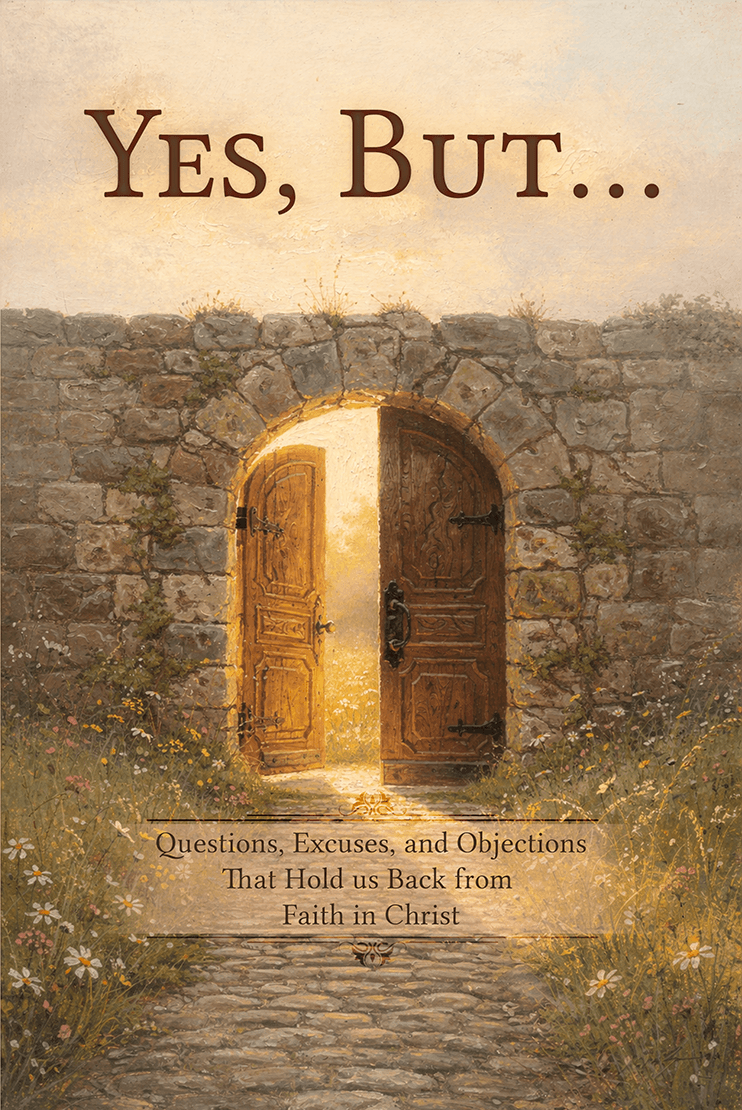
Anyone who has spoken with people about their souls knows how the conversation tends to go. You set Christ before them, you press the gospel call, and the reply comes back with an excuse: “Yes, but I cannot believe.” “Yes, but it must first be given to me.” “Yes, but what about election.” The booklet Yes, But… covers this subject. Its subtitle: Questions, Excuses, and Objections That Hold Us Back from Faith in Christ.
The structure is simple. After an opening appeal to come to Christ, the author works through twenty-seven objections, one short chapter at a time, and answers each from Scripture. A closing section gathers Bible texts for spiritual seekers, followed by a list of recommended books and a summary of all the “yes, buts” in order. The chapters are brief and densely referenced. The author plainly wants the reader to keep a Bible open and to test every claim against the text.
The book is at its strongest with the objections that grow not from ignorance but from distorted and misused doctrines. Election, human inability, and the sovereignty of the Spirit in the new birth are all true, and the introspective heart can turn each of them into a reason to wait rather than to come. The book holds the doctrines and still presses the duty: Christ is offered freely and sincerely, and the sinner is commanded to come now, not when he feels ready or sufficiently broken. Readers who have followed the older debates over hyper-Calvinism and the free offer of the gospel will recognize the ground at once.
Yes, But… comes from the Reformed Appeal Book Fund in the Netherlands, an effort to recover the unconditional gospel and the free offer of grace, and it stands in a long line of experiential Reformed writing. The author leans throughout on voices who pressed the same call, among them Spurgeon, Bonar, Ryle, Bunyan, and the older Scottish divines on assurance. The companion titles listed at the back, including Iain Murray on Spurgeon’s conflict with hyper-Calvinism, point in the same direction.
It helps to read the book as a tract rather than a treatise. The tone is direct and at times confrontational, in the manner of an earnest pastor pleading with a soul rather than a theologian laying out a system. The idiom is Dutch and experiential, and the English edition adds a few translator notes where a passage needs qualifying, such as the application of Revelation 3:20. None of this counts against the book, provided the reader takes it as a searching appeal to the conscience and not as a balanced summary of the whole counsel of God. On its own terms it does what it sets out to do.
The booklet will serve several readers. It speaks to the seeker who does not know whether he is allowed to come, to the long-time churchgoer who knows the language of grace but has never closed with Christ, and to the introspective Christian who cannot find assurance because he keeps looking inward for a warrant he thinks he lacks. It is also a natural book to give away, short enough to be read in an evening and pointed enough to be remembered.
Yes, But… is newly translated into English and available now on Amazon: https://www.amazon.ca/dp/B0H6FPJK27